
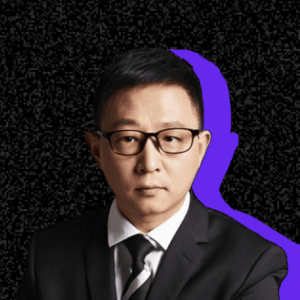
Song Hongbing, a world-renowned scholar on financial history. He is the author of the “Currency Wars” series and “HongGuan,” as well as the host of the internet talk show “Hongguan” and the financial program “Subcurrents.” He is also the founder of Hong Academy.
In 2007, he gained significant attention for successfully predicting the 2007 U.S. subprime crisis and the 2008 global financial meltdown in his book. This garnered huge reactions both domestically and internationally, and was extensively covered by media in over 30 countries and regions.
In 2009, Song Hongbing was named one of “China’s 40 Most Influential People” by Business Week, which has the highest global circulation among U.S. publications.
Since 2010, the term “Currency Wars” has been widely cited by politicians and media around the world, and the outbreak of global currency wars has become a focal point of international concern.
In December 2015, “Currency Wars 5” was launched at the Russian Presidential Hotel as a recommended book for the city of Moscow, and was read by President Putin.
In May 2016, upon the invitation of the President of Kazakhstan, Nursultan Nazarbayev, Song was the sole Chinese scholar representative to speak at the presidential roundtable, where three Nobel laureates in economics were also present. He learned that another attendee, Ryashimov, was also a devoted reader of “Currency Wars.”
The “Currency Wars” series has consistently topped China’s financial bestsellers list, with total sales in the millions. It has been translated into Korean, Japanese, French, Polish, Vietnamese, and Traditional Chinese, and continues to sell well overseas.
On February 14, 2016, the internet talk show “Hongguan” celebrated its first anniversary with a global viewership of 200 million. The show’s promo was even played at New York’s Times Square.
In June 2018, the financial program “Subcurrents” premiered exclusively on the iQiyi platform, earning a high rating of 7.5.
Currently, Song Hongbing has amassed a total of 5 million followers across various social media platforms, including WeChat, Weibo, Toutiao, and YouTube.
In 2016, inspired by the Athenian Academy, Song Hongbing founded Hong Academy. The institution has over 30,000 students, ranging from 13-year-old middle school students to octogenarians, hailing from more than 20 countries and engaged in various professions. At Hong Academy, students explore the values of self-discovery and world awareness, sharing cross-cultural, interdisciplinary, and cross-thinking methodologies while aiming for the spiritual goal of an Eastern Renaissance.
Here, we have the tried-and-true “Dollar Circulation” early warning model, which, with various leading indicators, allows investors to identify precursors to major global financial market upheavals, providing a valuable time window for escaping risk.
Here, structural analyses of the international financial system are provided, backed by multiple predictive reviews, giving investors a stronger “battlefield sense” of the interconnected mechanisms in financial markets.
Here, we offer analytical tools grounded in the historical and dialectic logic of economics from a monetary perspective. This helps investors to ignore temporary, transitional, and accidental factors, enabling them to grasp the long-term, structural, and inevitable nature of global economic trends, thereby becoming more insightful and forward-looking.
Looking back over the seven years since the founding of Hong Academy, Song Hongbing has made several highly accurate forecasts for the global financial market:
In July 2020, he precisely predicted that the impact of the pandemic on the world economy would last for three years, describing it as “three years of external deterioration, a secondary economic impact, and a long-term battle.”
In July 2021, he pointed out the structural and long-term nature of inflation, refuting the Federal Reserve’s “transitory inflation” theory.
In January 2022, he accurately assessed that 2022 would be a year of “reversal,” marked by a cooling dollar circulation, a global interest rate rebound, the Fed’s exit from QE, and deteriorating liquidity in the U.S. Treasury market.
In July 2022, he stated that stagflation-type recessions would occur in Western economies; continued tapering by the Federal Reserve would lead to a “money shortage” in overseas dollars.
In January 2023, he precisely anticipated a “volcanic shock” in the global financial markets. Two months later, several major banks faced bankruptcy, triggering a banking crisis in the United States.
He reaffirmed his long-standing view that the cornerstone of the new Eastern monetary order will be gold collateral + digital payment. This year’s facts have proven that, with central banks around the world having increased their gold reserves by a record 1,136 tons last year, demand for gold as a safe haven has intensified, pushing its price to repeatedly approach and break historical highs.
